 David Emery Online
Content Design
5 December 2009
There’s been a lot of talk recently over the inevitable meeting of something akin to traditional art direction and the (not so) humble blog post. Smashing Magazine – in a brief foray into something that wasn’t a list-based post – coined it the ‘blogazine’ which is a bit nasty but I guess will do for these purposes.
As that article name checks (and rips off) and I’ve mentioned before on these pages this whole thing (movement? Fashion?) was really spearheaded by Jason Santa Maria – although Khoi Vinh paved the way with A Brief Message – and has now spawned all sorts of great looking sites. I don’t think anyone is going to argue that it’s really nice to see a bit ‘design’ being integrated into online content, rather then the steady march of templated content that we normally see.
However, one thing I’ve being trying to experiment with recently is trying to pull some of this layout experimentation of out of the confines of the blog – where it seems to have stayed, to a certain extent (more on that later) – and into non-article, non-personal content. Not to say that it’s necessarily up to the standards of people mentioned previously, but hopefully it’s of some interest.
I’ve been trying out this experimentation on the Vampire Weekend website. As a bit of background, Vampire Weekend have a new album out at the start of January so over the last few months we’ve had a series of different bits of content we’ve wanted to roll out. Now, the site always has had a news section (and in fact we haven’t really touched the rest of the site) but it didn’t feel like that was really ‘enough’, and a bit of excitement and design was in order.
So, to announce the album we put up this page:
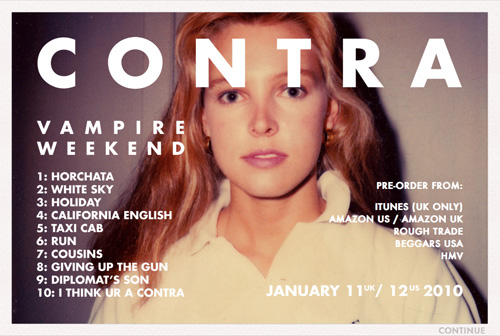
Now, obviously a splash page isn’t the most revolutionary move in the history of webdesign and in fact, most of the time I’d recommend against them, but when your key content (‘New album!’) needs communicating simply they can be effective.
This page also set up a bunch of design elements that then run throughout the sequence of pages: the one page view (using the techniques outlined in my last post), the 25px border with a slight polaroid texture to evoke the album artwork and obviously the font choice (lots of bold Futura).
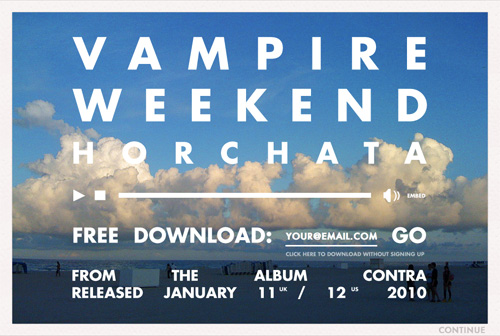
Giving away the first track of the album came next, and we used a very similar style but obviously different imagery. Interestingly enough, the style of the page also then spread out into the PDF lyrics booklet that accompanied it. Both, obviously, being inspired by the album and single’s artwork direction, but modified and changed to suit the web.
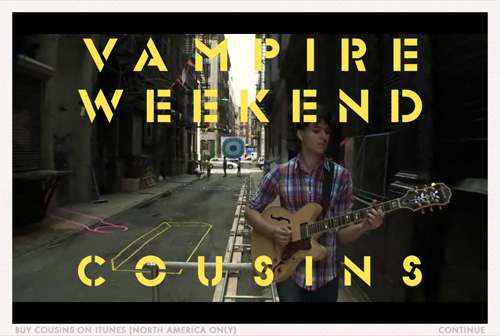
Last but no means least is the video (read: awesome video) for Cousins which presents itself in the same style as everything else: full screen, polaroid borders and dabs of Futura (which get out the way automatically before the video gets going, thanks to a hint of javascript). Also, at the same time we’ve been running a little site on the side with some short videos which plays with the same visual palette.
That’s what we’ve done so far (there should be more of it to come) and hopefully it gives you a bit of an idea of what I mean – the introduction of design and art direction into content on the web shouldn’t just be kept to blog posts.
One more thing; the big question surrounding this whole ‘art directed articles’ thing is ‘where is traditional media in all this?’. After all, magazines and newspapers already do this day in day out so why can’t they do it on the web as well? Certainly you don’t see much more then just templated posts, which is often especially galling when it’s content shared online with the print version; one with some design to it and one with a complete absence of it.
Especially confounding this is the occurrence of prototype tablet versions of magazines floating about, like this one of Sports Illustrated:
Why couldn’t this (or something easier to navigate, at least) just be the Sports Illustrated website? There’s nothing there you couldn’t do right now, on the web. It doesn’t need to be some probably-proprietry format (which is what they’re talking about), it just needs to be HTML.
I guess people forget you can do a hell of a lot in plain old HTML…