 David Emery Online
News Feed
26 June 2007
Dave Winer has an interesting post today linking to the new AOL News beta site, where he opines that the “River Of News” style presentation that they use should be used practically everywhere.
“River Of News” refers to the style of content blocks that blogs (this one included) commonly use, with the latest article at the top and earlier posts underneath in a reverse chronological order. The alternative to this is a format much more similar to traditional newspaper style design, with new items being organised by section or type with little attention being paid to time. Good examples of this are Yahoo.com and NYTimes.com.
I completely agree with Dave here – the “River Of News” format makes so much more sense online, when content is much more likely to be time sensitive. It also much more closely portrays the medium and the technology behind it; most sites are powered by CMS (Content Management Systems) that deal with pieces of content in this manner and internally sort them chronologically.
However, I’m beginning to think that there’s a great improvement to this style of content representation which could work really well across a wide range of different site types: the Combined River of News – also know as a News Feed.
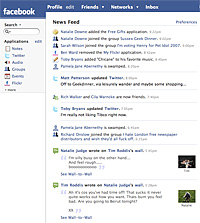 “News Feed” should probably ring a bell for most of you, as that’s what Facebook calls it, and it simply refers to a combined feed of information, across all different content types, ordered reverse chronologically. Each one is displayed in a similar style, but optimised for the content it is presenting; so photos show small photos inline, news items show the first couple of paragraphs, videos show a small embedded video etc.
The advantages are simple; at a glance, in one place, the user can see everything new that has occurred across a site. With user attention spans getting ever lower, with more and more content vying for their eyeballs this can only be a good thing.
Now, while Facebook is the most notable usage of this style of presentation I think their implementation leaves a lot to be desired. For a start, the list is totally dynamic and not strictly chronological – it will aggregate content together based on a whole range of factors, so you can never be sure you’re seeing everything as it may be hidden. Also, it’s one page, and one page only – there’s no propensity for looking through older events and items, so once things have disappeared it’s very difficult for the user to figure out where they’ve gone. This is why I guess that the page is more dynamic – it prioritises certain types of content (which you get to control via the preferences) so they don’t disappear as quickly.
However, I still think that the News Feed design pattern could potentially have a lot of use – see the short lived Tumblelog fad for example. I know I’m itching to try it out as soon as I find a suitable site – it could certainly work a lot better then multiple “section” summaries that adorn the home page of many sites at the moment.