 David Emery Online
Why All Those Records (Gaslight Anthem, Crystal Castles, Hole, Etc.) Leaked On Monday
Because PlayMPE--"one of a handful of technologies that record labels use to distribute advance, watermarked albums, to blogs, magazines, and a variety of other publications," reports AbsolutePunk.net--was hacked last week. PlayMPE is the preferred industry vehicle these days as far getting records to critics ahead of the official release date. But all it took was one clever teenager to get himself on the company's distribution list, and the rest was RapidShare history.
Ouch.
Visit ➔Apollo 11 Saturn V Launch
This clip is raw from Camera E-8 on the launch umbilical tower/mobile launch program of Apollo 11, July 16, 1969. [...] The camera is running at 500 fps, making the total clip of over 8 minutes represent just 30 seconds of actual time.
Awesome (in the true meaning of the word):
Visit ➔Design reset
It’s pretty clear this new fangled iPad is a reset in personal computing. I really hope this “reset” echoes throughout the web design community. The best example I’ve seen is from the New York Times.
The iPad has revealed a great deal when it comes to the design of websites. The app store is now full of apps that provide a nicer interface to a web app or site, but most of them don’t actually do anything that couldn’t be done on the web.
The New York Times app is a great example – it’s far nicer to read an article on it when compared to the website (which is full of clutter and visual noise). Now, obviously there’s some features that are iPad (or more specifically touch-interface) specific but there’s a lot that can be learnt in this space I think.
Also, on a similar note:
It seems that more and more Apps are replacing websites in a time when more and more applications are moving to the web. What exactly do we want? Email went from the Application to the Cloud with Gmail, and we love it. The same for Flickr for photos and Google Docs for documents. At the same time Twitter started out as a website but quickly moved to applications on multiple platforms. It is clear that just moving everything to the web isn’t the ultimate solution for everything. That eBay and IMDB app are clear examples.
Now, I don’t believe apps are the ‘death of the website’ as that’s obviously link-baiting hyperbole but there’s a kernel of truth in there…
Visit ➔LCD Soundsystem - Drunk Girls
"Drunk Girls" - taken from the new album "This is Happening" directed by Spike Lee
I never trusted pandas:
Visit ➔The Firefox 4 Download Manager
Alexander Limi elaborates on how Mozilla plans to improve the download manager in Firefox 4:
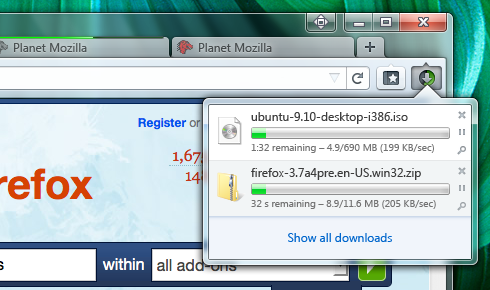
I wondered how long it would take for iPad UI elements (in this case pop-overs) to make their way over to the desktop. Answer: not very long.
Visit ➔Fun with social APIs: a pair of mini-apps
I’m very happy to say that we’ve recently released two free mini-apps meant to let artists do some fancy social network building on their own sites. They’re both simple PHP/Javascript apps that work with native APIs. One offers tweet-for-track capabilities for Twitter. The other encourages people to become fans on Facebook by offering a free download for all fans using Facebook Connect.
First off, let me just say I really admire what the guys over at CASH Music are doing; it’s great that there’s room on the internet for the intersection of Open Source and music, and that someone’s doing it.
However, am I the only one that has a great distaste with the whole ‘Tweet for a Track’ model? The premise is simple – to get a free MP3 download (or any other content, really) you have to let them post a promotional tweet using your twitter account.
The short term promotional benefits are obvious (lots of people tweeting about you or your content), and it seems like an easy shortcut to “viral” success but that’s just the problem; it’s a shortcut, not the real thing. A real viral success is something that people want to post to their twitter and tell all their friends about, and hence contains the authenticity of a genuine recommendation.
However, forcing someone to tweet (and often with a predefined message) just isn’t going to carry that same authenticity; it’s just going to feel like marketing to anyone reading it (and no one likes to think they’re affected by marketing). Not only that, the person you’ve forced to tweet isn’t going to feel great about inflicting it upon their friends either.
It turns something that should be exciting (getting a bit of content for free) into something that feels, well, icky.
Visit ➔House Season Finale Filmed Entirely with Canon 5D Mark II
The season finale of the popular TV show House, which will air on May 17th, was filmed entirely with the Canon 5D Mark II.
Very interesting – what with the occurrence of RED One video cameras being used to shoot magazine covers, these two once separate industries seem to be converging pretty quickly.
I do love the look you get shooting video with a DSLR (not that I have any interest doing it myself – it’s all about the stills for me).
Visit ➔Popular Science+
In December, we showed Mag+, a digital magazine concept produced with our friends at Bonnier.
Late January, Apple announced the iPad.
So today Popular Science, published by Bonnier and the largest science+tech magazine in the world, is launching Popular Science+ — the first magazine on the Mag+ platform, and you can get it on the iPad tomorrow. It’s the April 2010 issue, it’s $4.99, and you buy more issues from inside the magazine itself.
BERG seem to be doing some incredible work of late, and this is no exception. Unlike some of the iPad magazine demo videos that have been going round in recent weeks this is grounded in reality; no crazy custom video elements, just the existing magazine content repurposed brilliantly for a touch based, animated environment.
Visit ➔It's Not the Pay, It's the Wall
...the issue I’m interested in is whether it’s possible for a news site to exist behind a wall of any sort. Anyone who runs a relatively well-trafficked website will be able to tell you that it’s typical for the majority of traffic to be fly-by visitors from search engines and organic website referrals. A relatively smaller percentage of visitors arrive at your site by purposefully navigating directly to it (keying the URL, hitting a bookmark etc).
Drew hits the nail on the head here; there is nothing wrong with paying for content online, but putting a block between you and most of your visitors is never going to work on the web.
It’s not so much that people will actively choose to go elsewhere, more that they won’t be driven there as no-one will link to it.
Contrast that with the App store (which will soon be an Apps+Magazines+Newspaper store) where links don’t matter; what matters is popularity and familiarity. Existing print offerings have both of these in spades.
Visit ➔