 David Emery Online
Kazaa, Skype Founders Launch Twitter-Like Music Service Rdio
Janus Friis with Niklas Zennström, who disrupted music distribution with the Kazaa file sharing service and phone companies with Skype, unveiled their Twitter-like version of a digital music service at the crack of midnight Thursday morning.
Rdio offers instant access to more than 5 million tracks from all the major labels and several indies to listeners in the United States and Canada through a web browser, downloadable software or mobile app. It’s available for free for three days and then for fees of $5 (web only) or $10 (web plus mobile).
Looks like a great service, but I can’t help but think that the pricing model doesn’t quite work; the lack of a free, ad-supported version (even if it’s limited to x amount of hours per month) is going to hamper adoption.
It’s why Spotify is doing so well, obviously; their subscriber levels are doing nicely, no doubt in part due to their mobile app, but I don’t think they’d get many people starting off on the paid plan without growing to love it via the free version first.
I also imagine it’s exactly the existence of the free plan – the one that makes it all work – that’s stalling Spotify’s launch in the US.
Visit ➔The Wired App
Whatever happens, and whatever conventions we end up with, I suspect that the reality will be at once quite wonderful if you stop to think about it, but disappointingly dull and prosaic on first impressions. I doubt we’ll have a wow moment from it, which is, I think, kind of the point.
I found myself nodding along whole heartily whilst reading this post. Yes, the Wired app isn’t perfect – especially in its construction – but it’s a pretty good first effort.
Visit ➔Is This Really The Future of Magazines or Why Didn’t They Just Use HTML 5?
However, what strikes me most about the Wired app is how amazingly similar it is to a multimedia CD-ROM from the 1990’s. This is not a compliment and actually turns out to be a fairly large problem…
I’m a fan of the Wired app – more on that soon – but its construction (lots of .pngs with some XML glue) seems woefully inefficient.
Visit ➔How The UK Times’ New Paid Website Will Look
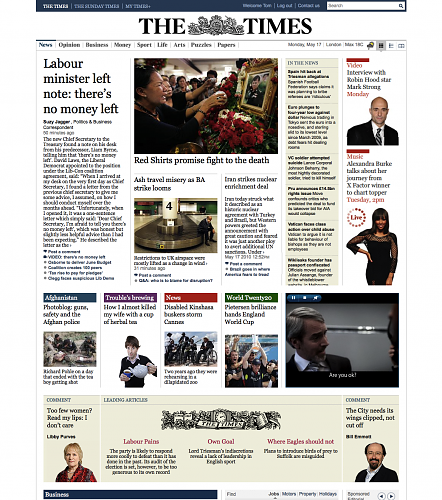
While I’m a long way from being convinced that the paywall is an idea that’s good, or that it’ll work, this redesign – going from these screengrabs – looks like it’s actually a pretty good one.
Visit ➔Leave Britney Alone! (Where by Britney I mean Steve, Mark and Jimbo)
The problem here is one of perspective. We hardcore internet users might do well to realise that, just because we spend our days trawling TechCrunch and TechMeme and Hacker News doesn’t mean that the wider world shares our belief that privacy settings for photos we’ve chosen to post online, Flash on the iPad or our God-given right to see erections on Wikipedia are the most important issues in the world today.
I’m beginning to link to every column Paul Carr writes for TechCrunch, because he’s the only one in the tech media that seems to have any sense of perspective.
Don’t agree with Apple’s App Store policies? Don’t buy an iPhone.
Don’t agree with Facebook’s privacy policies? Don’t use Facebook.
It’s not difficult.
Visit ➔Six Degrees of Black Sabbath
Find the path that connects two artists
I think it’s impossible to go to this site and not get sucked in for at least 10 minutes.
Visit ➔On Turning The Page
Just let me scroll, please? I’ve been reading stuff off the screen seriously for what, 15 years? More? Scrolling is fine, you know.
I’ve been thinking a lot recently about the whole “pages versus scrolling” thing and I have to say I’m veering towards – at least on touch-based devices – pages being preferable. On the desktop, with scroll-wheel mice, scrolling works well but the incessant “swipe, swipe, swipe” method on mobile devices is pretty tiresome – especially as commonly there’s no quick way of jumping ahead like there is in a regular scrolling environment (which is one of the key benefits of scrolling).
Visit ➔Facebook Breached My Privacy, And Other Things That Whiny, Entitled Dipshits Say
In other words, their problem is not that something ended up online, simply that they were unable to keep control of something they willingly shared with at least a portion of the world. And it’s that attitude that needs to change – from one of retroactive bleating about privacy to one of proactive filtering of what we choose to share in the first place.
Blaming Facebook’s flaky approach to privacy for the ills of the exhibitionist generation is just yelling at the stable door, long after the horse has bolted.
Surprisingly for something on TechCrunch, this article is right on the money. I appreciate that, judging by the amount of people on Twitter* that seem to hate Facebook, I may be in a minority in my peer group but I have no problem with Facebook, and a fairly relaxed attitude to online privacy.
The key to me is just to assume that everyone can read or view anything you put on the internet, wherever that is, and act accordingly. It's the internet: you don't have any control, so don't worry about it.
* Most of which have public Twitter streams, Just sayin'.
Visit ➔